Game Rules
Learn the flow of a round in Riichi Mahjong
Overview
A round in Riichi Mahjong follows a simple cycle until someone wins or the wall runs out of tiles.
- Each player receives 13 tiles (dealer receives 14)
- Players take turns drawing and discarding tiles
- Players can call other players' discards to form melds
- The round ends when a player completes a winning hand or the wall is exhausted
The Initial Deal
At the start of a round, each player is dealt 13 tiles from the wall. The dealer (East) receives 14 tiles and starts the round.
Example starting hand (13 tiles):




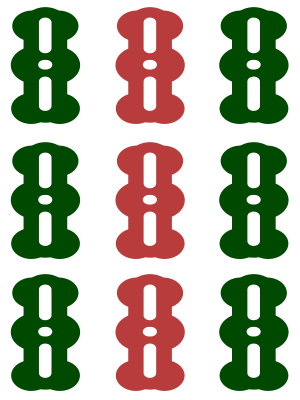


The goal is to form a complete hand of 14 tiles (4 melds + 1 pair).
Draw and Discard
On your turn, you draw one tile from the wall and then discard one tile. This continues counterclockwise around the table.
Draw
Take one tile from the wall to add to your hand (now you have 14 tiles).
Discard
Choose one tile to discard face-up in front of you (back to 13 tiles).
Calling Tiles
When another player discards a tile you need, you can call it to form a meld. This is called "naki" in Japanese. Calling opens your hand, which affects scoring.
Chi (Sequence)
Call a discarded tile from the player to your left to complete a sequence (e.g., 2-3-4).
Chi example:

Pon (Triplet)
Call a discarded tile from any player to complete a triplet (three of the same tile).
Pon example:
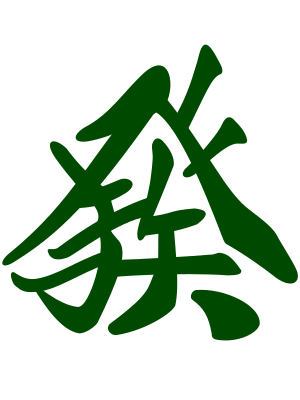
Kan (Quad)
Declare a quad of four identical tiles. You draw a replacement tile from the dead wall.
Kan example:
Note: Calling opens your hand, which means you cannot declare Riichi and some yaku are reduced or unavailable.
Riichi Declaration
When your closed hand is one tile away from winning (tenpai), you can declare Riichi by placing a 1000-point bet. Riichi is a powerful move that adds 1 han to your hand and enables additional bonuses.
- Your hand must be closed (no called melds except closed kans)
- Your hand must be tenpai (one tile away from winning)
- You must have at least 1000 points for the bet
Riichi-ready hand waiting for:
Winning the Hand
There are two ways to complete your hand and win:
Ron (Win by Discard)
Win by claiming another player's discarded tile that completes your hand. The player who discarded pays the full points.
Tsumo (Win by Self-Draw)
Win by drawing the winning tile yourself from the wall. All other players pay you points.
Winning hand (13 tiles + winning tile):
A standard winning hand consists of 4 melds (sequences or triplets) and 1 pair. Special hands like Chiitoitsu (seven pairs) have different structures.
Scoring Overview
The value of a winning hand is determined by yaku (hand patterns), fu (minipoints), and dora (bonus tiles).
Yaku (Hand Patterns)
Yaku are specific patterns or conditions that give your hand value. You need at least one yaku to win.
Fu (Minipoints)
Fu are additional points based on the composition of your hand (triplets, kans, wait type, etc.).
Points Calculation
The final score is calculated from han (yaku value + dora) and fu using a formula or limit values.